Ethiopian Traditional Jewelry: Crosses, Mateb and the Meaning Behind the Metal
A complete guide to Ethiopian traditional jewelry — the Lalibela, Axum and Gondar crosses, the mateb cord worn from baptism, gold vs silver traditions, and how jewelry is worn with the habesha kemis.
Illustration
The Mateb: Where Jewelry Begins
Before any gold or silver enters the picture, there is the mateb. The mateb is a cord — traditionally twisted from blue or black silk thread — that is tied around the neck of every Ethiopian Orthodox Christian on the day of their baptism. For boys this happens forty days after birth, for girls eighty days. The priest blesses the cord and places it on the infant, and from that moment forward the mateb is worn continuously. It is the first piece of jewelry an Ethiopian person receives, and for many it is the most important one they will ever wear.
The mateb is a physical sign that the wearer has been received into the Ethiopian Orthodox Tewahedo Church. It is not optional and it is not symbolic in the way a charm bracelet might be — it is sacramental. Removing it deliberately is understood as a renunciation of faith, and many Ethiopians will not take off their mateb even during surgery or in situations where other jewelry is removed. The cord itself wears over time, fraying and thinning with daily life, and when it breaks or degrades it is replaced with a new one, often by a priest during a brief blessing.
The tradition of wearing a visible sign of Christian identity was formalized in the fifteenth century under Emperor Zara Yaqob, who issued a decree requiring all baptized Christians to wear the mateb cord and a cross. Zara Yaqob was a zealous reformer who sought to consolidate Orthodox practice across the Ethiopian highlands, and the mateb decree was part of a broader campaign to make Christian identity legible and public. The practice predates his reign — archaeological evidence and church records suggest it was already widespread — but his decree gave it the force of imperial law, and it has remained unbroken since.
The cross that hangs from the mateb is the centerpiece of Ethiopian jewelry. It is not chosen casually. Regional identity, family tradition, and personal devotion all play into the selection. Some families pass a specific cross down through generations, restringing it on a fresh mateb cord each time. Others commission a new cross from a silversmith for a wedding or a baptism. The cross and the mateb together form a single unit — the cord is the foundation and the cross is the visible statement — and that unit is the starting point for everything else in Ethiopian adornment.
The Three Great Regional Crosses
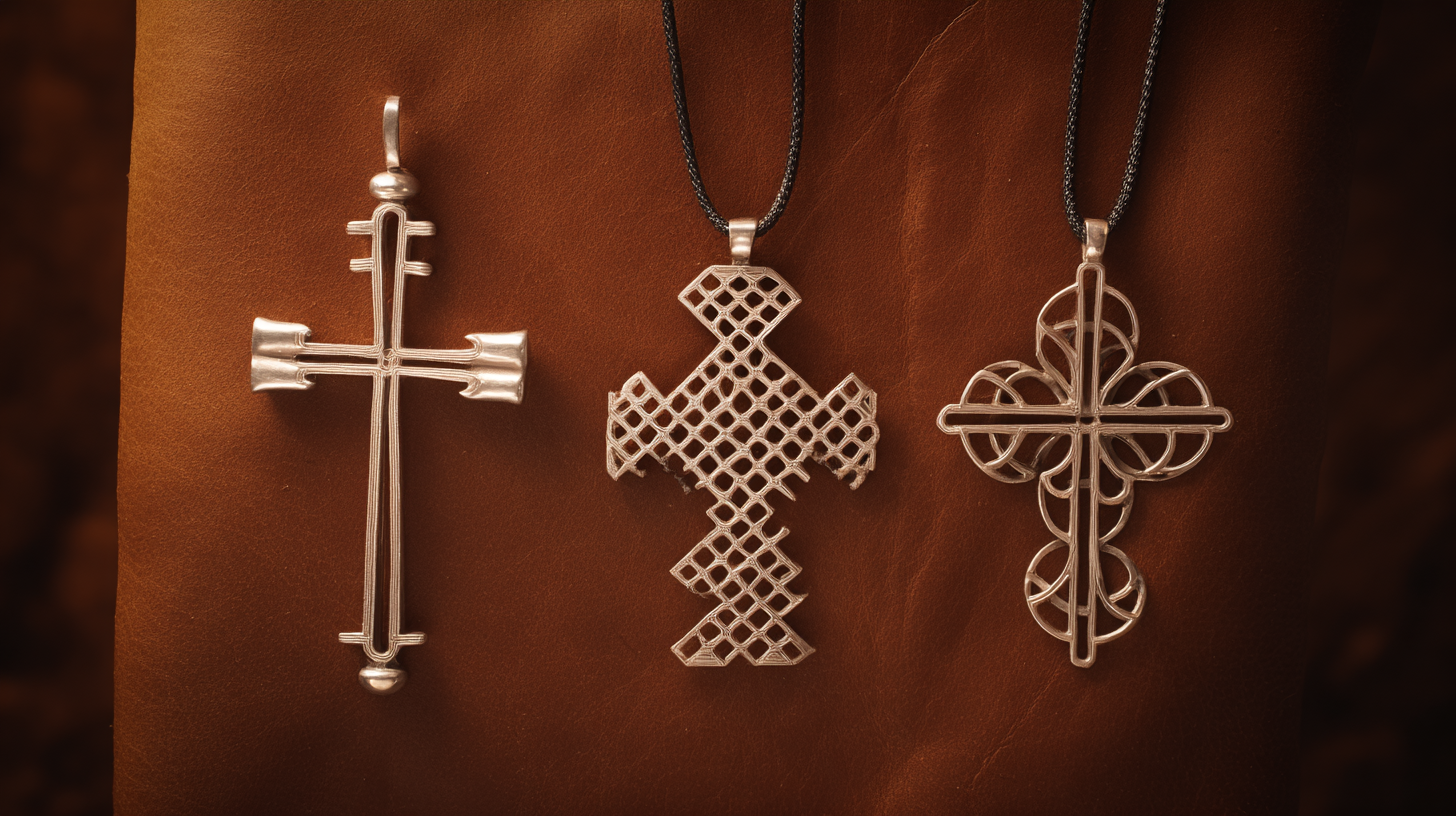
Ethiopia has hundreds of cross designs — some scholars have catalogued over two hundred distinct forms — but three regional traditions dominate the landscape and account for the vast majority of crosses worn today. Each one reflects the history, theology, and artistic temperament of the city where it originated.
The Axum Cross is the oldest tradition, tracing its lineage to the fourth century when the Aksumite Empire became one of the first states in the world to adopt Christianity. The Axum cross is defined by geometric simplicity: a long vertical axis, a shorter horizontal bar, and spherical or bulbous shapes at the ends of each arm. Some versions feature a flat, open lattice within the arms, but the overall silhouette is restrained and architectural, reflecting the monumental stone tradition of Aksumite building. The Axum cross does not try to be ornate. Its power comes from proportion and weight — a well-made Axum cross in solid silver has a gravity to it that more elaborate designs do not always achieve. For Tigrayans and many highland Ethiopians, the Axum cross is the original and the purest expression of Ethiopian Christian identity.
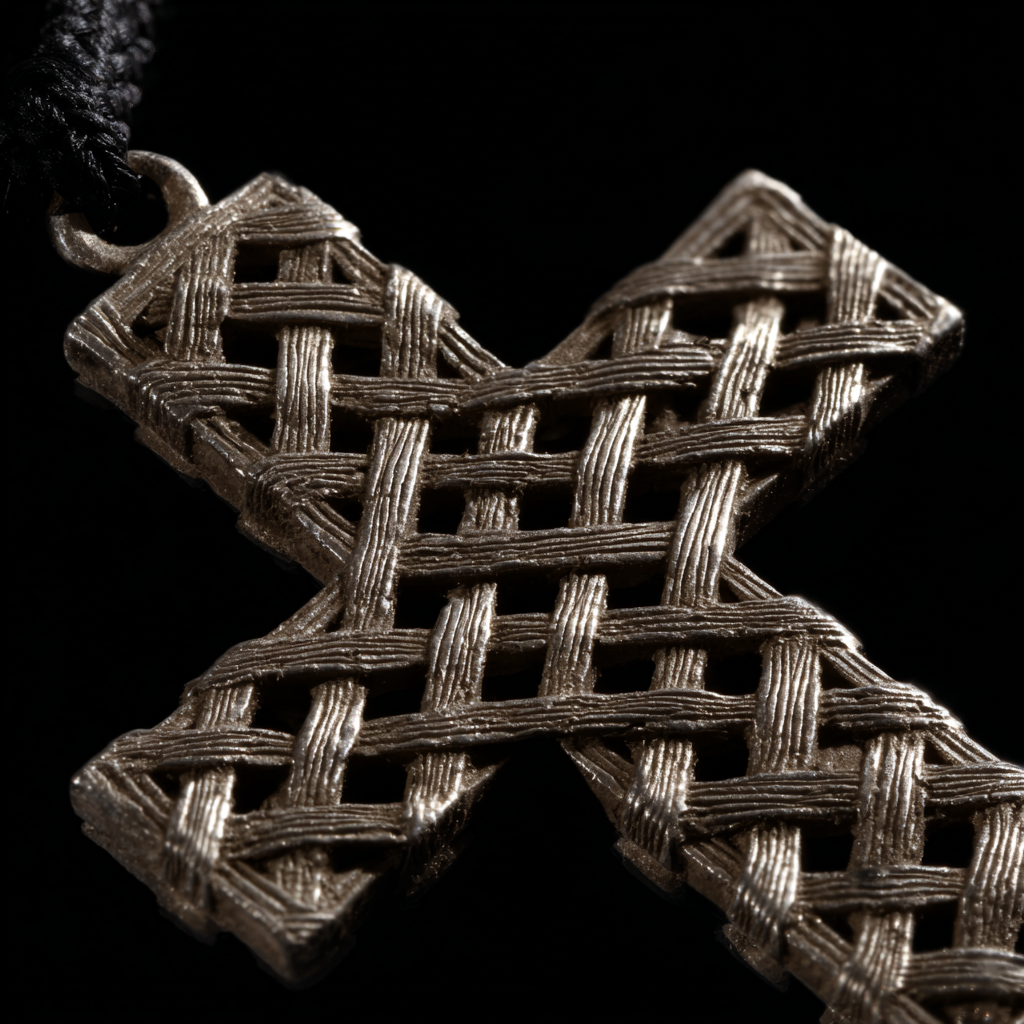
The Lalibela Cross takes complexity in the opposite direction. Named after the rock-hewn church complex in the Amhara highlands, the Lalibela cross is built on an interwoven lattice pattern — a continuous line that folds back on itself without ever breaking. This unbroken line is deliberate: it represents eternal life, the idea that the faithful soul has no beginning and no end. The arms of the Lalibela cross often terminate in spearhead-shaped tips, which are traditionally associated with the Seal of Solomon and the Solomonic dynasty that ruled Ethiopia for centuries. The lattice work is intricate and demands exceptional skill from the silversmith — a single error in the lost-wax casting or the hand-carving of the mold will break the continuous line and ruin the symbolic integrity of the piece. Lalibela crosses are the most visually complex of the three traditions and are often the ones that non-Ethiopian buyers find most striking.
The Gondar Cross reflects the imperial grandeur of the city that served as Ethiopia's capital from the seventeenth to the nineteenth century. Gondar crosses are characterized by circular and rosette motifs — concentric rings, petal shapes, and rounded forms that give the cross a softer, more ornamental quality than the angular Axum or the interlocking Lalibela. The rosette motif is linked to the Solomonic dynasty and the imperial court, and Gondar crosses often incorporate elements borrowed from Portuguese and Armenian artistic traditions, reflecting the cosmopolitan character of the Gondarine capital. Gondar crosses tend to be broader and more medallion-like than other Ethiopian crosses, and they are frequently the choice for formal ceremonial wear, particularly in the Amhara region.
Gold and Silver: Regional Traditions
The choice between gold and silver in Ethiopian jewelry is not purely aesthetic — it carries regional, economic, and social meaning that has developed over centuries of highland culture.
Gold is the metal of ceremony and formality. In the Amhara and Tigrayan bridal traditions, gold jewelry is a central element of the wedding. The bride receives gold from her family — earrings, necklaces, bangles, sometimes a full set called a silt — and this gold serves a dual purpose. It is adornment for the ceremony, but it is also the bride's personal financial security. Traditionally, a woman's gold belongs to her alone, not to her husband or his family, and it can be sold or pawned in times of hardship. This practice turns jewelry into a portable savings account, and it explains why Ethiopian families will invest heavily in gold for a daughter's wedding even when money is tight. The gold is not a luxury — it is a provision. Pieces are passed through generations, melted down and recast when styles change, but the gold itself is understood as a continuous family asset.
Silver has its own deep tradition, particularly in Tigray and the northern highlands. Ethiopian silversmiths developed exceptional filigree techniques — thin silver wire twisted, coiled, and soldered into lace-like patterns — that rival the best filigree work from the Mediterranean or South Asia. Silver crosses, in particular, are considered by many purists to be the authentic form: the earliest Ethiopian crosses were cast in silver or bronze, and gold crosses are a relatively modern development. The weight and cool tone of sterling silver give crosses and pendants a gravitas that gold does not always match, and silver filigree earrings remain a signature of Tigrayan formal dress.
In the diaspora, the practical reality of cost has given rise to a third category: gold-plated jewelry, typically eighteen-karat or twenty-four-karat gold layered over a sterling silver base. Gold vermeil — a thick plating of at least 2.5 microns over silver — has become the most popular option for diaspora buyers who want the warm color of gold without the four-figure price of solid pieces. When buying gold-plated Ethiopian jewelry, the key question is the thickness of the plating and the quality of the base metal. A well-made vermeil cross over sterling silver will last years with proper care. A thin flash-plated cross over base metal will tarnish within months.
How Jewelry Is Worn with the Habesha Kemis
Ethiopian jewelry is not layered or mixed the way contemporary Western fashion jewelry often is. There is a grammar to it — a set of conventions about what goes where and how pieces relate to each other and to the garment they accompany.
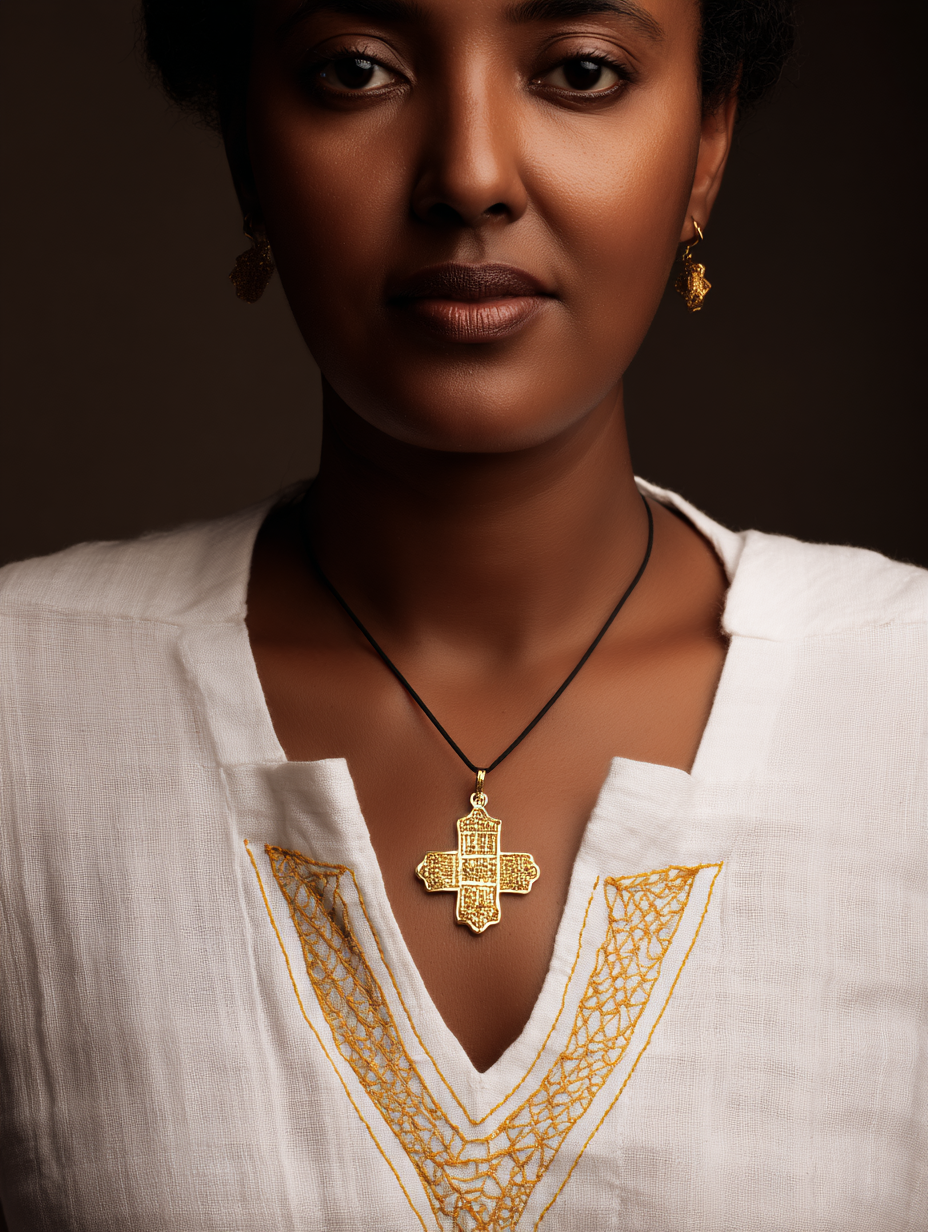
The cross on the mateb sits at the centre of the neckline, resting against the chest just below the collar of the kemis. This is the anchor piece, and everything else defers to it. The cross should not compete with the tibeb border of the dress — if the kemis has heavy, elaborate tibeb, a simpler cross is appropriate; if the kemis is more understated, a larger or more ornate cross can take prominence. This balance between garment and jewelry is intuitive to most Ethiopian women but often missed by diaspora buyers assembling a look from separate sellers.
Earrings are the second essential element. Traditional Ethiopian earrings are gold drops or small hoops — delicate enough for daily wear, substantial enough to catch light at a ceremony. For weddings and major holidays, larger chandelier-style gold earrings are common, often matching the cross in metal type and weight. Modern ceremonial earrings have grown larger and more elaborate, influenced by broader East African and Middle Eastern bridal trends, but the classic Ethiopian gold drop earring remains the standard.
Bangles and bracelets are worn in pairs — one on each wrist — for formal occasions. Gold bangles for weddings, silver for less formal events. The meqenet, a woven belt or sash worn at the waist of the kemis, sometimes incorporates metallic thread or small decorative elements that echo the jewelry above. Together — cross, earrings, bangles, meqenet — the full set creates a coherent visual line from neckline to wrist to waist, each element complementing the tibeb of the dress without overwhelming it.
Buying Ethiopian Jewelry as a Diaspora Buyer
If you are purchasing Ethiopian jewelry from outside Ethiopia — whether for a wedding, a baptism gift, or your own collection — there are several markers of quality and authenticity worth knowing before you spend.
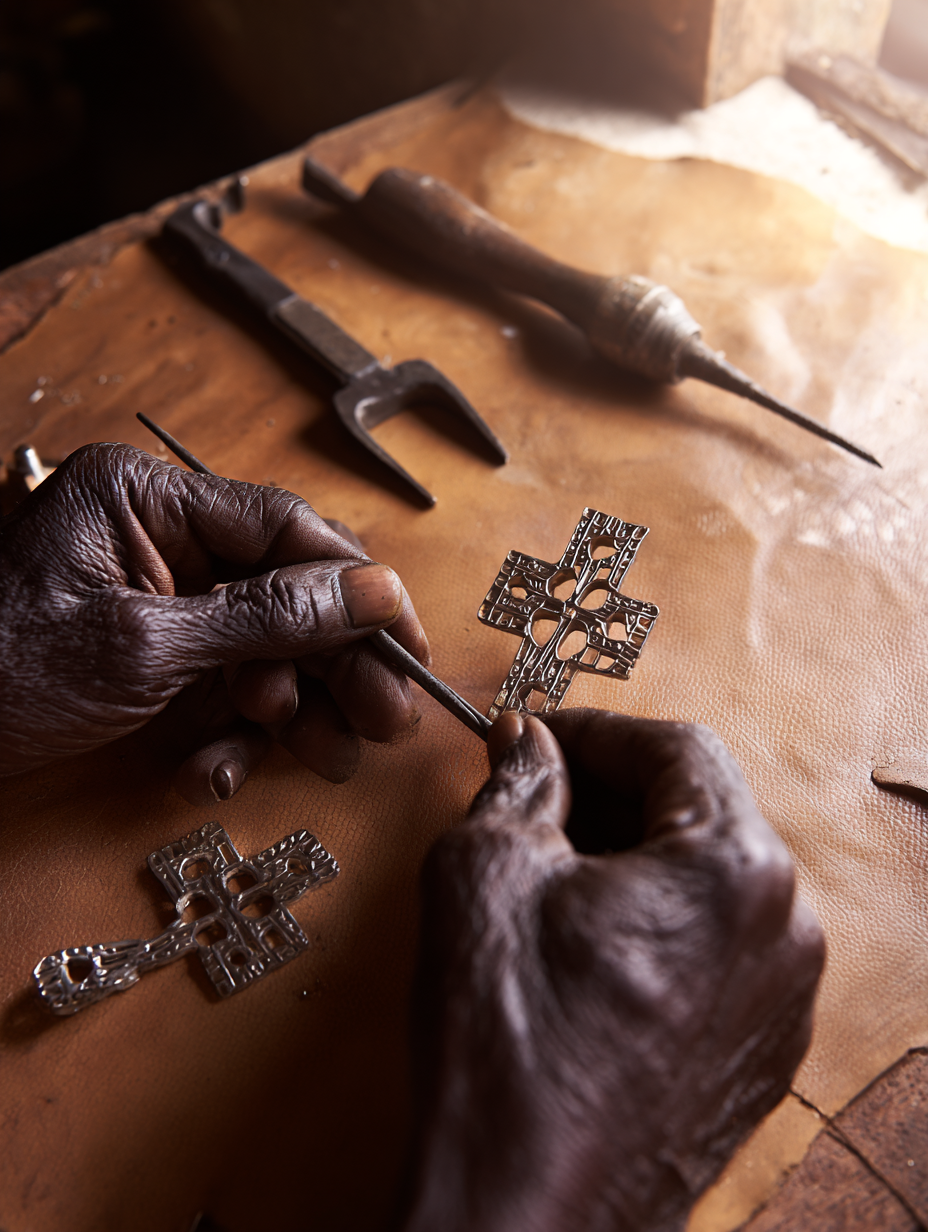
Hand-cast crosses are made using the lost-wax method (cire perdue), a technique Ethiopian metalsmiths have used for centuries. A wax model of the cross is carved by hand, encased in clay, and heated until the wax melts out, leaving a mold into which molten metal is poured. Each hand-cast cross is slightly unique — there will be minor asymmetries, tool marks on the back, and a tactile weight that machine-stamped crosses lack. If a cross looks absolutely perfect and identical to every other cross in the listing, it was almost certainly die-cast or stamped from a machine mold. That is not necessarily bad, but it is a different category of object and should be priced accordingly.
Sterling silver should be marked 925, indicating 92.5% pure silver. Ethiopian-made silver pieces are not always stamped (hallmarking is not as standardized in Ethiopia as in Europe), but a reputable seller should be able to confirm the silver content. If the price seems remarkably low for a solid silver cross, it may be silver-plated brass or nickel alloy — ask directly.
Gold vermeil should have a minimum plating thickness of 2.5 microns over sterling silver. Anything thinner is technically gold-plated, not vermeil, and will wear through faster. Ask the seller about the karat of the gold layer (18K and 24K are most common) and whether the base is sterling silver or a cheaper alloy.
The mateb cord should be included with any cross sold as a complete set. A quality mateb is tightly twisted, even in diameter, and made from silk or silk-blend thread. The traditional colors are blue, black, or a deep indigo. If a cross arrives without a mateb cord, you can purchase one separately from most Ethiopian church supply sellers, but a good jewelry seller will include it as standard.
Finally, consider the regional tradition of the cross you are buying. If you have roots in Tigray, an Axum cross carries meaning that a Gondar cross does not, and vice versa. If you are buying as a gift for someone else, learning which cross tradition their family follows is a gesture of respect that will be noticed and appreciated. Ethiopian jewelry is personal in a way that goes beyond taste — it encodes identity, faith, and belonging, and choosing well is its own form of care.